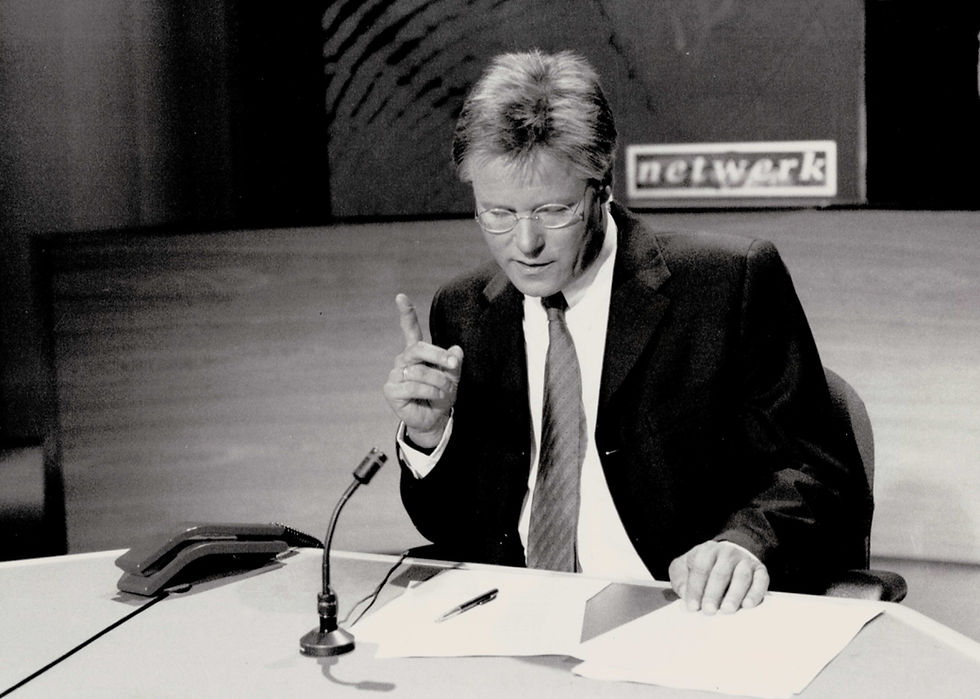
Netwerk
"From day one, millions were glued to their screens. A crying shame that it was ruined by broadcasting politics."
It was a bold adventure that began while I was traveling in South Africa with my incomparable NCRV colleague, Cees Labeur. There, as editors-in-chief, we came up with the idea of merging the current affairs programs Brandpunt (KRO), Hier en Nu (NCRV), and Televizier (AVRO)—and later also EO’s Tijdsein.
Netwerk: broadcast every evening, right after the Journaal, in a fixed time slot—going head-to-head with the major entertainment shows on other channels in fierce competition for viewers.
Some broadcasters, especially the KRO, had a hard time with it. Discontinuing important titles in favor of a collaboration was a bitter pill to swallow. But why waste so much money, energy, and quality on your own channel by airing at inconsistent times and falling off the viewer’s radar?
And then, the impossible happened. From day one, millions of viewers were glued to their screens. Netwerk was, above all, a reportage program—a tribute to all those makers trained in the art of visual storytelling. At the time, there were still generous budgets, which allowed us to invest in background reporting on world news, original perspectives, in-depth research, and political coverage.
Together with talents like Karel van de Graaf and Aart Zeeman, I was fortunate to help set a new tone in the current affairs landscape. I daresay: never before had so much journalistic storytelling power come together day after day under a single title. I remember it as a celebration.
That the program later fell victim to broadcasting politics still strikes me as a loss—and frankly, a disgrace. But what a joy it was, for so many years, to have the privilege of shifting boundaries together, for a large and loyal audience.